
Many of the digital workplace strategies we are asked to review are documents rather than decisions. They set out an ambition, name a few platforms, and leave the genuinely contested questions such as what to build or switch off, for somebody else to settle later. They swerve the important details that a digital workplace strategy requires to make it credible and implementable.
That is rarely a writing problem. It is a research problem, as usually the strategy is not built on a comprehensive discovery exercise, but instead found on assumptions rather than data. The strategy was assembled from what the project team already believed, and with no evidence layer underneath it, meaning every recommendation is open to argument.
In summary
A digital workplace strategy is a plan that sets out how an organisation will use technology to support and likely improve the way its people actually work. Essentially it contains an evidenced current state, a vision of a future state and the steps required to get there; this usually incorporates detail such as the reasons for changing the current digital workplace, the scope of the processes and technologies covered, a segmented view of the workforce, individual business objectives per function, a high-level roadmap, and a measurement strategy. Strategies fail when they are written from assumption rather than research, do not have agreement from stakeholders, or are scoped as a single programme too large for anyone to approve or realistically deliver.
What is a digital workplace strategy?
A digital workplace strategy is a document that connects business objectives, employee needs and the technology you already own or need to procure into a sequence of decisions you can fund. It is not a technology roadmap, and it is not a business case for a list of products you intend to buy. However, both of those are things a strategy might produce.
We see many organisations who think they have a digital workplace strategy, but actually it is more of a deployment plan involving Microsoft 365 and AI services. It says nothing about why those tools are being deployed, for whom, and what would count as success.
What should a digital workplace strategy contain?
The format of a digital workplace strategy may well differ from organisation to organisation, but essentially it should include the following elements:
What should a digital workplace strategy contain?
The format of a digital workplace strategy may well differ from organisation to organisation, but essentially it should include the following elements:
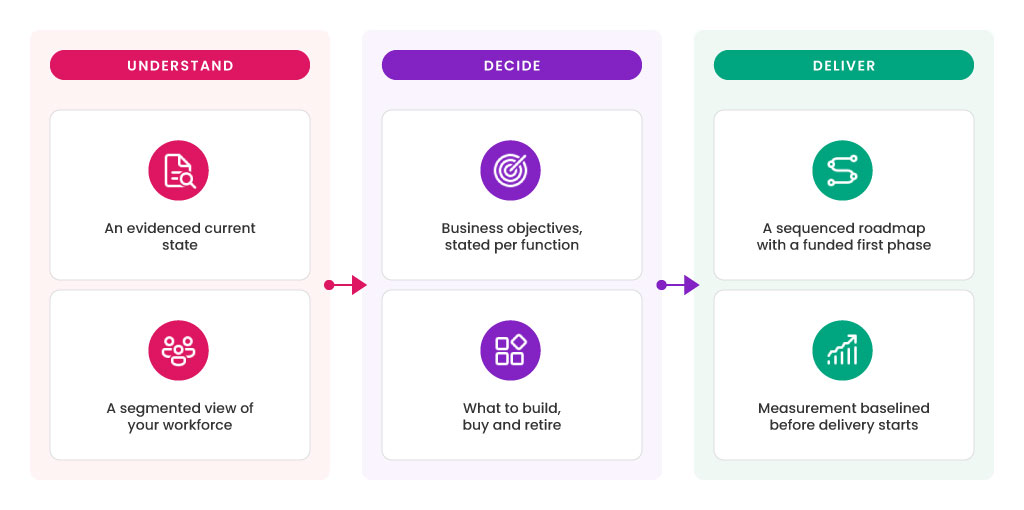
1. An evidenced current state incorporating user and stakeholder research
Some strategies open with a software inventory and call that the current state, but this doesn’t tell you about what people use, associated costs, where the friction sits and the opportunities being missed. A strategy needs information to show why you need to move from the current state. Always include evidence that incorporates user and stakeholder research, as well as usage data, service desk record and search logs.
2. A vision of a future state aligned with organizational strategy
A strategy has an end goal – the future state you want to get to. Providing some details of what this looks like and what the headline benefits will be for your business and your employees is critical. Usually this will be aligned with organisational strategy, for example a commitment to digital transformation, a need drive growth, increase productivity, or leverage AI.
3. An overarching mission statement and guiding principles
A digital workplace strategy should include a simple mission statement which encapsulates the essence of what is being delivered, and a reflection of the “why”. Adding four of five guiding principles also provides more details on the main pillars or principles of the strategy
4. A clear scope for the digital workplace
There is no set definition of where the digital workplace starts and stops. It could encompass the central tools provided across Microsoft 365, or include core systems like Workday, or even incorporate all applications and platforms used across different lines of business. Defining the scope of what is covered is critical. Bear in mind that organisations that have too wide a scope can impact their chance of success.
5. A segmented view of your workforce
This is where strategies can come apart. Roles, locations, languages, working patterns and technical confidence all differ, and one group’s essential tool is another group’s clutter. Head office requirements tend to be well represented. Frontline and deskless requirements tend to be assumed. A strategy built around an average employee produces a digital workplace that serves everybody equally and nobody particularly well.
6. Business objectives for different functions
IT, internal communications, HR and operations will all want to get different things from the same platform. A strategy that only states a single shared objective will be missing the target. Capturing the details of different objectives across different support functions and noting any differences is important for gaining consensus, while also ensuring there is alignment with the roadmap across all the key business stakeholders.
7. Decisions on what to build, buy and retire
Include what to switch off. For example, most organisations already have capabilities in Microsoft 365 they have never configured, and a strategy that skips this step will recommend buying something twice.
8. A sequenced roadmap reflecting priorities with workstreams
The digital workplace strategy should include a high-level roadmap with a sequence that reflects priorities and any dependencies. Having a view of the different workstreams involved – for example covering technical elements, content, change management and so on, will help for more detailed and realistic project planning. In considering the steps, phase one needs to be small enough to approve on a single budget cycle. A business case based on a strategy that asks for the whole programme up front usually gets nothing at all.
9. Success criteria with measurement baselined before you start
A strategy should include success criteria which are aligned with what you’re trying to achieve with the project. Linked to this should be specific KPIs and measures. Having baseline numbers from your current state is the way to go; increases in adoption cannot be evidenced retrospectively. If nobody measured how long it took to find a document before the project, you cannot credibly claim to have improved it afterwards.
10. Details of governance and ownership
Your digital workplace strategy isn’t going to happen all by itself, and stakeholders won’t sign off on something without some clarity over who is likely to be responsible for it, who is going to pay for it, and the wider governance required to make it happen. Always include some high-level details of governance and ownership so everybody is on the same page and it is clear that the digital workplace strategy is realistic.
Why do digital workplace strategies fail?
They fail for reasons that are usually visible in the document itself, before delivery starts.
- Built on assumptions. A digital strategy that is not based on an evidence-based view of how employees work and any pain points will not succeed.
- Written by the people who will implement it. The strategy just recommends what the team already wanted to build and does not have consensus or input from other business stakeholders.
- Borrowed whole from an analyst framework. Four pillars, five pillars, seven pillars. The frameworks are useful scaffolding, but a strategy that would fit any organisation fits none of them in particular.
- No evidence layer. Every recommendation stays contestable, so decisions get made by whoever is most senior or most persistent rather than by what the data is saying.
- An unrealistic scope. Too wide to implement or too large to fund, so the strategy remains a document. This is the most common failure we see and the easiest to avoid.
- Change management is only treated as a launch activity. Adoption is either designed in from the start or retrofitted expensively afterwards.
“The strategies that succeed in the real world are the ones where every recommendation can be traced back to something we found out, rather than something we assumed. When a stakeholder challenges a decision six months in, you want to be able to show them the research rather than re-run the argument.”
John Scott, UX director, Content Formula
Strategy, roadmap, discovery or business case?
These four terms get used interchangeably and they are not the same artefact, although there can be some overlap. Confusing them is one reason strategies stall – a board asked for a business case and received a strategy, or a delivery team asked for a roadmap and received an ambition.
| Artefact | What it is | What it answers | Signed off by |
|---|---|---|---|
| Strategy | The set of decisions | Why this, for whom, in what order | Board or exec sponsor |
| Discovery | The research that produces the decisions | What is actually true about our organisation | Project sponsor |
| Roadmap | The sequence of delivery | What happens when, and in what order | Programme or delivery lead |
| Business case | The funding argument | What it costs and what it returns | Finance or the board |
The table separates them cleanly, which real projects rarely do. In practice one piece of research produces all four, which is why the sequence matters more than the labels: research, then decisions, then sequence, then the funding argument built from all three.
How do you build a digital workplace strategy?
Carry out any user and stakeholder research first. That means user research with a genuine cross-section of the workforce, stakeholder interviews across the functions that will make claims on the platform, a review of the existing intranet and its information architecture, a thorough look at the data you already hold, and a technical assessment of what your tenant can already do.
Everything in the ten components above comes out of that work. We have written separately about how a digital workplace discovery runs, what it produces and how long it takes – that page covers the method in detail rather than repeating it here.
If you are not sure whether your strategy has an evidence layer
There is a quick test. Can you state what your frontline staff need from the digital workplace, with evidence, without asking anyone? If the answer involves checking with a colleague, the strategy is resting on an assumption that has not been tested – and that assumption is usually the one that determines whether anybody uses what you build.
Digital workplace strategy
What is a digital workplace strategy?
A digital workplace strategy sets out how an organisation will use technology to support the way its people actually work. It connects business objectives, employee needs and existing technology to cover the steps to take a digital workplace from its current state to a desired future state. It covers the details of what to build, buy or retire, but it is distinct from a deployment plan, which lists platforms and dates without establishing why.
What should a digital workplace strategy contain?
Ten components; an evidenced current state based on research and usage data; a vision of a future state aligned with business strategy; an overarching mission and guiding principles; a clear scope for the digital workplace; a segmented view of the workforce rather than an average employee; business objectives stated separately per function; decisions on what to build, buy and retire; a sequenced roadmap based on priorities and dependencies; success criteria with measurement baselined before delivery starts; details about governance and ownership.
How long does it take to develop a digital workplace strategy?
The research underneath it typically takes two to twelve weeks depending on the size and complexity of the organisation, and writing the strategy itself is a small proportion of that. A strategy produced without research can be written in a fortnight, which is why so many exist and so few get funded. However, it can take significantly longer to arrange review, input, agreement and consensus from different business stakeholders.
What is the difference between a digital workplace strategy and a roadmap?
The strategy contains the decisions and the reasoning. The roadmap contains the sequence. A roadmap without a strategy is a list of deliverables with no argument behind them, which is difficult to defend when budgets are challenged or priorities shift.
Who should own the digital workplace strategy?
It needs an executive sponsor with authority across IT, internal communications and HR, because those functions will all have differing views and specific needs relating to the digital workplace. Where ownership sits with one function alone, that function’s priorities tend to dominate and the strategy stops being organisational.

John Scott
With Content Formula since 2006, John is the person who makes business solutions employees actually want to use. He leads UX and design across hundreds of SharePoint projects, bringing a rare combination of design sensibility and deep technical understanding. John bridges the gap between what a business needs and what the technology can do – and makes it look like it was always meant to work that way.