
Summary
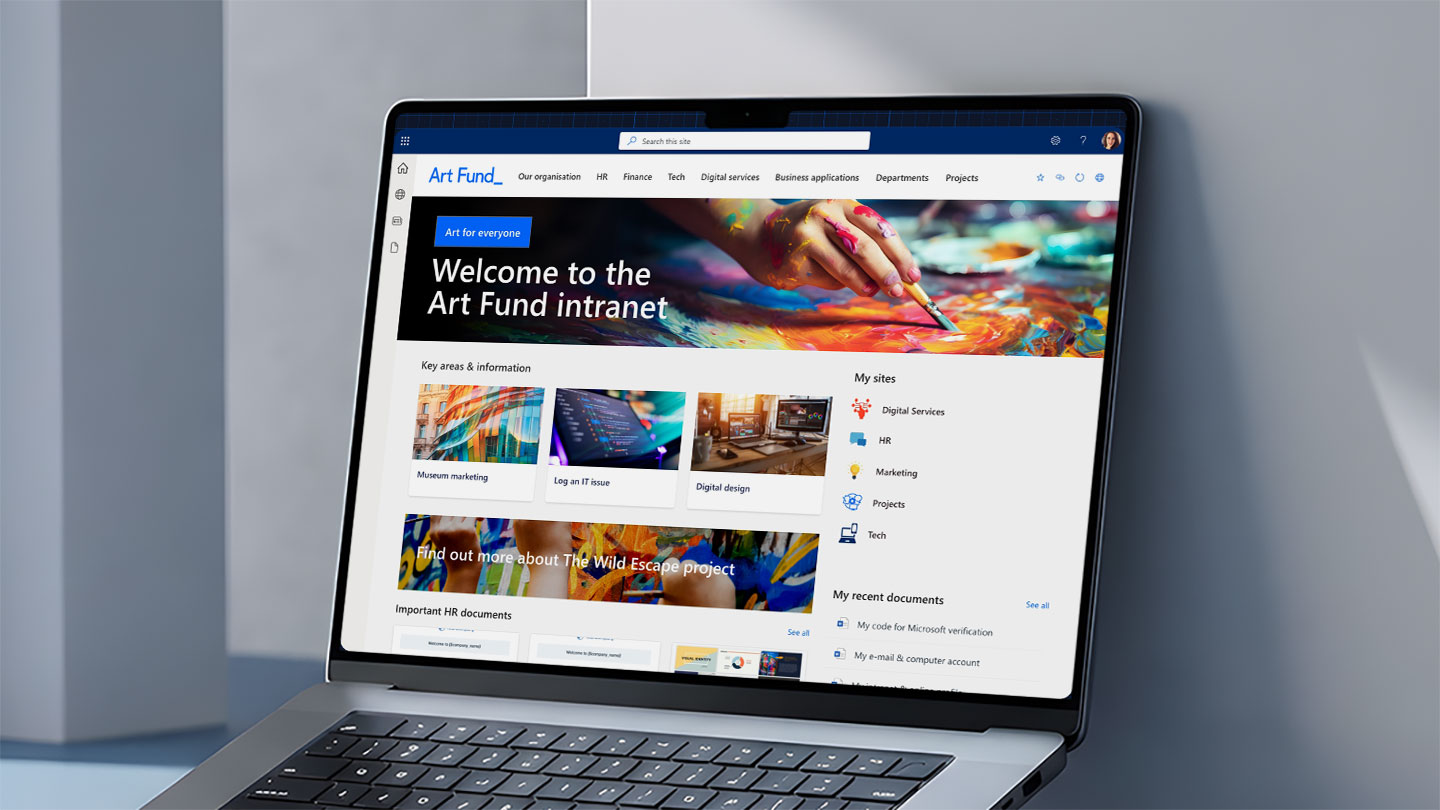
Art Fund is the national fundraising charity for art, best known publicly through the National Art Pass. It gives grants that help museums and galleries across the UK acquire and share works of art, funded by around 142,000 members rather than government or lottery money.
They came to us needing a document management system, a hub site and department pages built properly on SharePoint Online, not a single-site refresh. We delivered a SharePoint Online service covering DMS, hub architecture and department content, alongside Viva-related work, as a phased programme running from design and development through to migration and training. Art Fund kept working with us afterwards, including a substantial piece of follow-on work, which is usually a good sign that a platform is being used rather than left alone.
Building a real SharePoint DMS, not a document library with better labels
Most SharePoint projects that get called a ‘DMS’ turn out to be a document library with better labels. Art Fund needed something closer to the real thing: a document management system that could sit underneath a hub site and a set of department pages, and hold up once several teams were filing into it at the same time.
The brief, as it came through, combined two different problems under one project. A DMS has to get metadata, permissions and findability right before a single document is migrated. A hub site and department pages are a content and navigation problem, closer to design than data. Running both together meant the dependencies between them, who owns which library, how department pages surface documents, what the permission model looks like across teams, needed to be worked out early, or they would surface later as rework.
That is the structural version of the problem. Not “we need a nicer SharePoint site,” but “we need documents and content that behave consistently once several teams are using them at once.”
Does this sound like your own SharePoint estate? If document sprawl and disconnected department sites are the starting point for your organisation too, get in touch and we can talk through what a DMS project like this would take.
Why review the existing architecture before building the DMS?
Before any of the DMS build started, we reviewed the existing architecture: how the current system actually worked, and where the gaps were. That mattered because the document management system, the hub site and the department pages all draw on the same foundations, metadata, permissions and structure, so getting those wrong early would have surfaced as rework across all three later. This was not a strategy exercise to decide what Art Fund should do. It was the groundwork needed to build the DMS correctly: you cannot design a metadata structure or a migration plan without first knowing what you are migrating from.
The delivery itself was phased: design and development on the DMS, hub site and department pages were substantially complete well ahead of migration and training, which were scheduled as a separate stage. That sequencing meant Art Fund could see and sign off the structure before the harder part of the project, moving the actual content across, began. The migration itself was a genuinely complex piece of work: legacy content rarely maps cleanly onto a new taxonomy, and the gap between what you thought was in the file share and what is actually there usually only shows up once you start moving it.
What was delivered
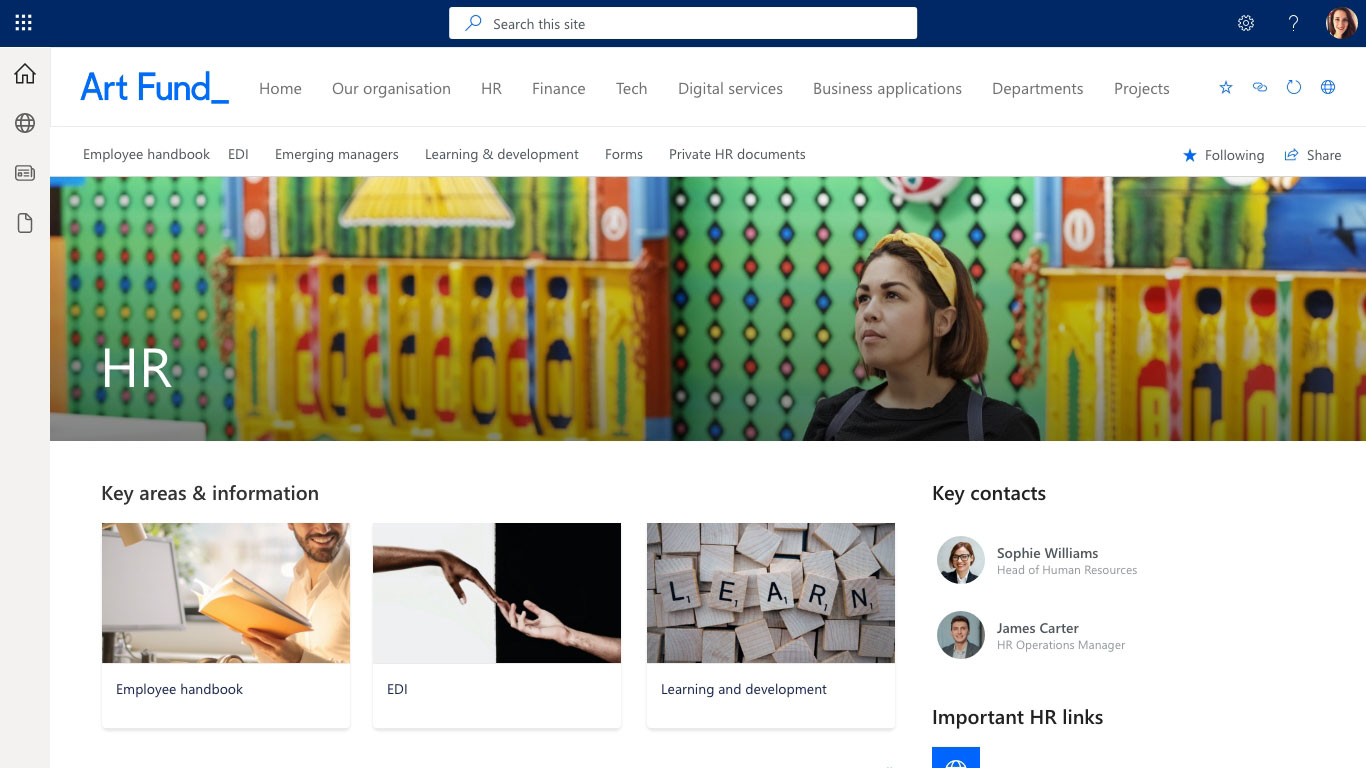
The clearest description of the finished environment is a SharePoint Online service for Art Fund covering a document management system, a hub site and department pages.
The document management system was the part the project was really commissioned to solve. In practice, that means a structure where documents carry consistent metadata, sit in the library that the right team owns, and can be found by someone outside that team without asking around first. That is the difference between a place to put files and a system that holds up once several departments are using it at the same time.
The hub site gives Art Fund a single point of navigation across the department areas underneath it, rather than a set of disconnected sites that only make sense to the people who built them. For a multi-team organisation, that matters more than it sounds. It means someone new to a department, or moving between teams, has one consistent way to find their way around rather than relearning navigation every time.
The department pages sit underneath that hub, each one built around what that team actually needed rather than a single template stretched across every department. Design and development on these were substantially in place well ahead of the migration and training that followed.
The environment kept moving after go-live. We worked with Art Fund on a separate piece of follow-on work, which extended the DMS and page structure. That is usually the clearest sign that a platform delivered its brief: people are still building on it rather than working around it.
Curious what a properly structured document environment could do for your organisation? Take a look at our knowledge management services to see how we approach it.
Why it mattered
Art Fund did not come to this project short of documents. Most organisations in this position are not. What they lacked was a structure that made those documents findable, and hub and department pages that gave people a sensible route to reach them. Left unaddressed, that is not a dramatic failure, it is a slow one: more time lost searching, more duplicated versions in circulation, and more reliance on whoever happens to remember where something lives.
None of that holds up on technology alone. A DMS only earns its place once people trust it enough to stop keeping their own copies on the side, and that is a habit question as much as a configuration one. Technology gets you the structure. Getting people to rely on it is the part that takes longer.
We do not have formal adoption numbers to put against this project, and we will not manufacture some to fill the gap. What we can point to is a project that stayed active well past go-live once the new structure was in daily use. That, more than any single feature, is the real measure of whether a SharePoint DMS project worked. Not that it launched, but that it kept doing the job with less and less input from us.